Projects Showcase

Mars Rover Human-in-the-Loop Pick-and-Place

Mars Rover Human-in-the-Loop Pick-and-Place

DAM Robotics Club rover arm that lets an operator point to pick and place targets via an ArUco pointer.

About Me

From mental math to building systems

Growing up, I loved numbers and making things. I’d rattle off mental arithmetic to impress my parents’ friends and, as a teen, built a hydraulic arm that became my first real “engineering constraints” lesson. I posted game tutorials for fun, which nudged me into programming and, eventually, engineering.

I care about robotics, automation, AI, and AR, and I’m motivated by building systems that are useful, accurate, and delightful to use.

Outside class and work I balance badminton, ballroom dance, and hosting themed events with heavy workloads. Teaching is a through-line: designing explanations, tools, and interfaces that help people learn faster.

Students coached
0+
Tutoring hours
0+
Robotics & Mechatronics EnthusiastHardware & Software EngineeringBuilder • Teacher • TeammateEsports World Champion (2022)Funny Friend

Speed Math — 60s

60s
Solve as many as you can in 60 seconds.
Score
0
High
0
Percentile
0%

Outside School/Work

BadmintonBallroom danceHosting themed partiesFriends & hangoutsPhoto/Video editing (Adobe)TravelingTrying new food spotsLearning new things

Senior Capstone | ENGR 415/416 | Team D605

Woodpecker LSEV: Four-Wheel Steering & Sensor Platform

Bringing an open-source, wooden-chassis low-speed electric vehicle to a rolling, steerable, sensor-ready state.

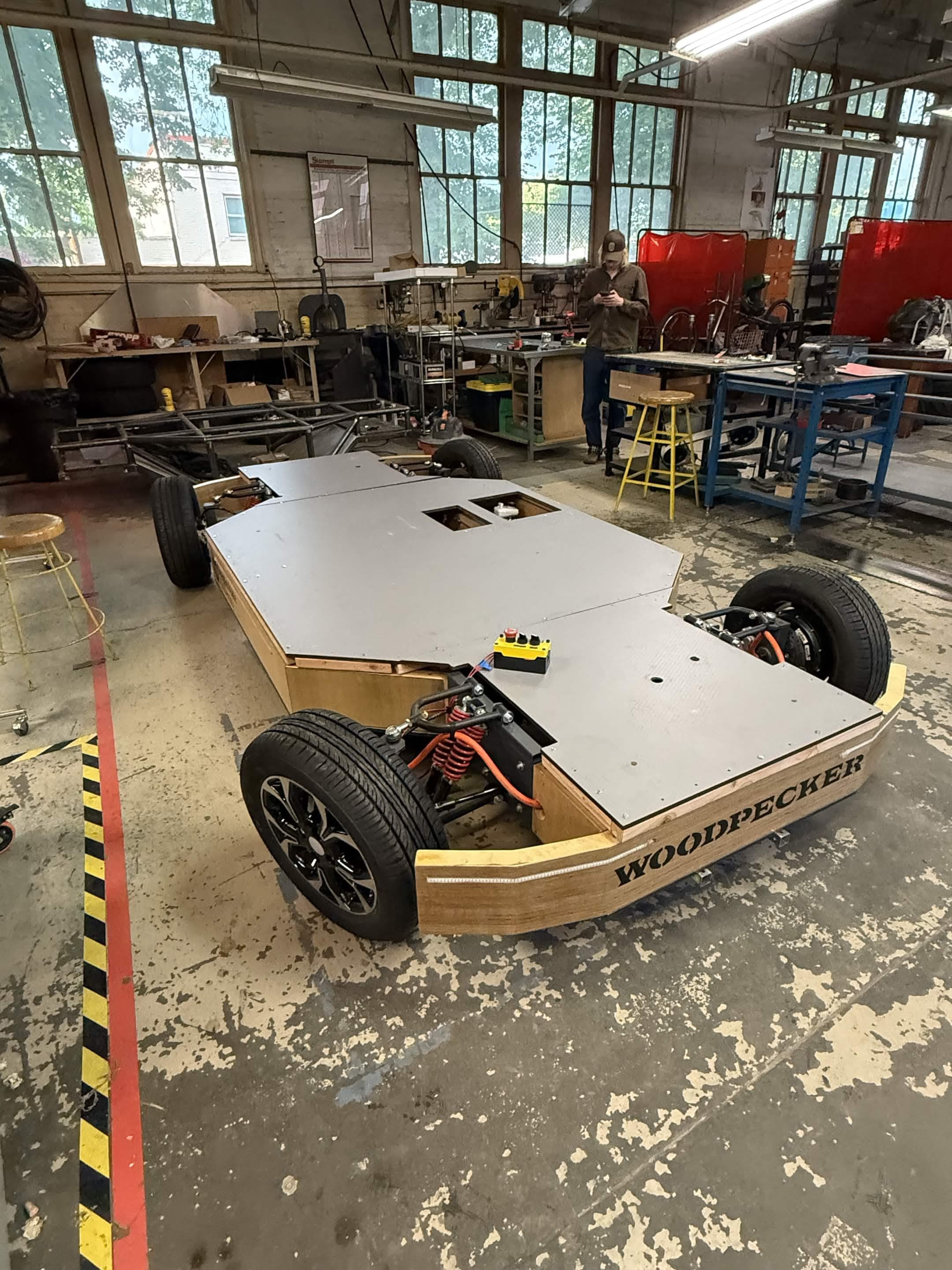
Woodpecker LSEV rolling chassis in the shop: wooden frame, four wheels with suspension and steering installed, gray platform deck on top.
The Woodpecker LSEV with wheels, suspension, and steering installed.
Role
Mechanical integration: steering, wheels & platform
Team
6 engineers (5 ME · 1 ECE) · Sponsor: Michael O'Halloran
Targets
30 ft turning diameter (±1.5 ft) · ±5° steering-angle tracking · E-stop integration
Status
Rolling, steerable chassis; passed initial unloaded testing of steering, braking, and throttle

Deliverables

Individual

Design Proposal

Outlines Team D605's plan to integrate a four-wheel steering kit and sensor-ready mounting interface into the Woodpecker LSEV while avoiding scope creep into full autonomy software. Defines success metrics such as a 30 ft turning diameter target, ±5° steering accuracy, emergency-stop support, and a simulation to test workflow for validating steering geometry, mounting stiffness, and future sensor placement.

Open proposal (PDF) ↗
Team

Final Report

Presents the continued development of the Woodpecker Low Speed Electric Vehicle through steering integration, structural reinforcement, and sensor-ready platform improvements. The project improved steering rack support, addressed packaging issues from battery and chassis constraints, and advanced the vehicle toward a more functional, testable, and expandable low-speed electric platform.

Open report (PDF) ↗
Team

Team Charter

Defines the team's purpose, goals, roles, communication rules, and accountability expectations for the Woodpecker LSEV capstone project. Establishes each member's responsibilities across simulation, CAD, testing, manufacturing, logistics, and project coordination, plus the teamwork, sponsor communication, and prototyping strategies needed to complete the project.

Open charter (PDF) ↗

Reflection

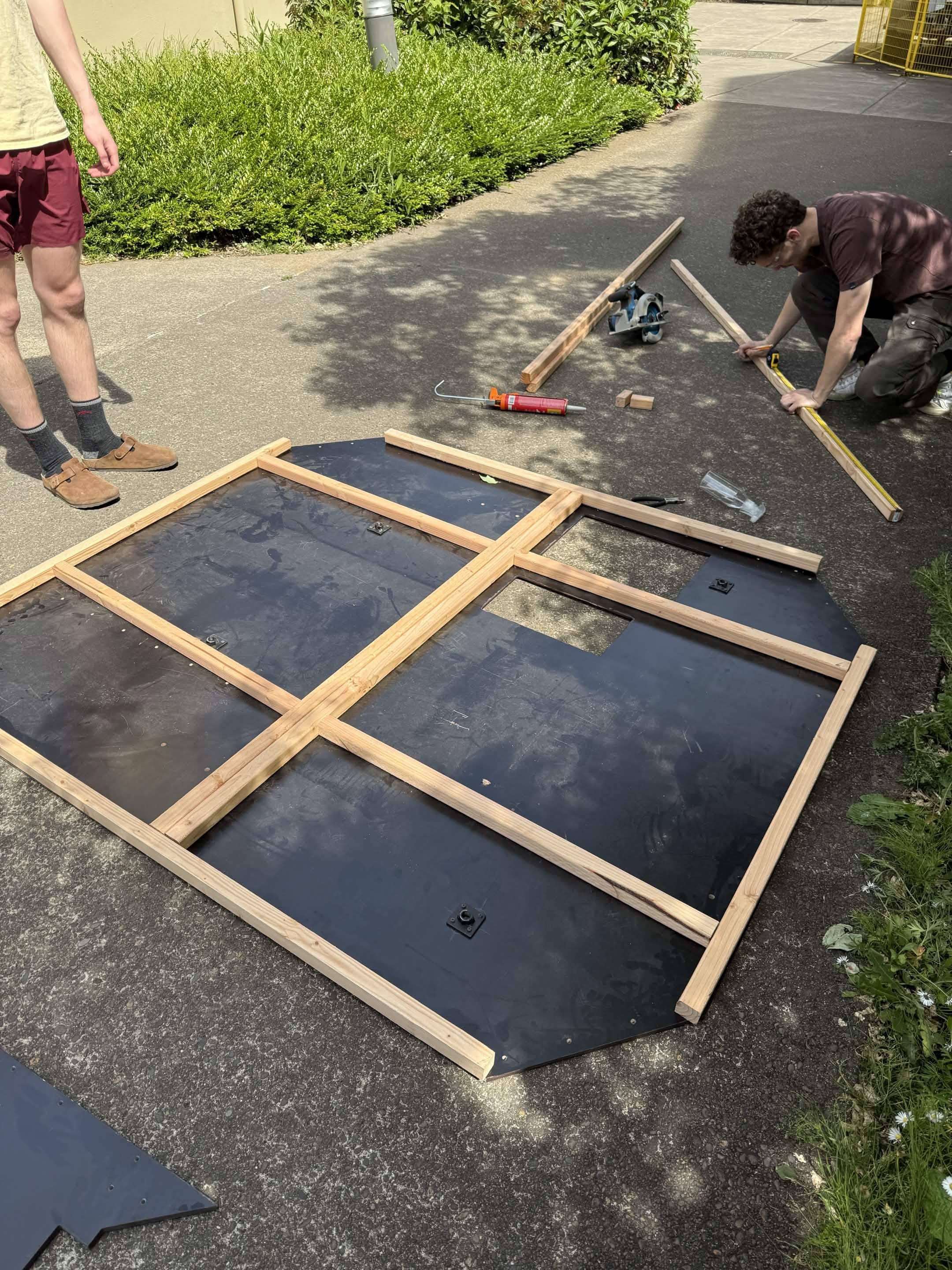
Building the raised platform: a 2×2 lumber support frame fastened to the underside of the black platform panels, with teammates measuring and cutting outside.
Raising the platform on a 2×2 support frame to clear the battery and steering hardware.

For my senior capstone, our six-person team worked to bring the Woodpecker LSEV, an open-source, low-speed electric vehicle built on a wooden chassis, to a drivable state. My hands-on contributions centered on attaching the wheel and steering assemblies to the vehicle and raising the platform to clear newly installed components. Five of the NACE competencies stood out in that work.

Critical ThinkingNACE
When the larger lithium battery and steering hardware went in, they interfered with the platform cover. Instead of cutting into the chassis or relocating components, we worked through the clearance options and I helped build the fix we chose: elevating the platform on a 2×2 wood support frame attached to the existing cover and frame. It cleared the interference, preserved the vehicle's geometry, and left room for future teams to add hinged access. That taught me to identify the actual constraint, clearance instead of component placement, before committing to a fix, which is exactly how I'll need to approach hardware problems in industry.
TeamworkNACE
Attaching the wheels and steering couldn't be done alone because aligning control arms, linkages, and wheel assemblies on a wooden chassis took multiple sets of hands checking each other's work. The platform rebuild was the same: teammates measured and cut lumber while I laid out and fastened the frame to the panels. With six defined roles and Discord as our channel, we redistributed work quickly whenever assembly surprised us. I now know what it feels like to be one person on a team whose parts literally have to fit together.
CommunicationNACE
Assembly problems only got solved as fast as they got reported. When fitment issues appeared during the steering installation, raising them immediately at meetings let the team adjust before they became rework. I also helped document the platform modification in our final report so the next capstone team understands why the platform sits higher and how to build on it. Clear status reporting and handoff documentation are habits I'll use from my first week on the job.
ProfessionalismNACE
Our charter committed each of us to 10 to 12 hours per week, and the build phase demanded it. The vehicle only became a rolling, steerable platform that passed initial unloaded testing because people consistently showed up for shop sessions. Steering hardware also leaves no room for sloppy fastening or alignment, since mistakes there are safety problems. Capstone reinforced dependability and attention to detail as professional baselines, not extras.
Career & Self-DevelopmentNACE
My internship background is software and embedded systems, so I deliberately leaned into the mechanical side of this project by wrenching on suspension and steering, fabricating the platform supports. It rounded out hands-on hardware skills that complement my embedded and robotics career goals, and it showed me the value of honestly assessing my gaps and choosing work that closes them.

Capstone made my work carry real consequences for the hardware, for my teammates, and for the teams who inherit the vehicle, and that's the habit I'm taking into my career.

Projects

Mars Rover Human-in-the-Loop Pick-and-Place
  • Scanned the workspace with a gripper-mounted Intel RealSense D405 to build a point cloud for scene understanding.
  • Segmented the ground plane and clustered objects with PCL, then detected ArUco pointer pose in OpenCV and computed ray-to-plane intersection for operator intent.
  • Selected the nearest object cluster to the intersection point and planned/executed approach, grasp, and place trajectories with MoveIt2 on the 6DOF arm.

ROS 2 · MoveIt2 · PCL · OpenCV · Intel RealSense D405

Open on YouTube ↗
Color Chaos: Block Attack Mode (Hiwonder ArmPi)
  • Built camera-based color detection for red, green, and blue blocks and randomly selected one visible block as the attacker.
  • When two or more blocks were visible, the arm picked the attacker, performed an attacking animation, and dropped it onto another randomly selected target block.
  • When only one block was visible, the arm still performed pickup + attack animation, then yeeted the block to a random off-board location.

Hiwonder ArmPi · Computer Vision · Color Detection · Robot Manipulation

Open on YouTube ↗
HOLOMAT: Touchless ROS 2 UI (Hand + Voice)
  • Built hand_tracking_node (ROS 2 + MediaPipe) → publishes fingertip TF frames + MarkerArray for AR/telemetry.
  • Wrote calibration_node (Python/NumPy) → 5×5 homography, persists M.npy for repeatable cam↔projector alignment.
  • Added voice_command_node + ui_display_node (OpenAI API + Pygame) → hands-free launches with logging/monitoring.

ROS 2 · Python · MediaPipe · OpenAI API · Pygame

Open on YouTube ↗
Cocktail Maker (HW/SW Mechatronics)
  • Modeled + 3D-printed assemblies; firmware & keypad UI for recipe selection + pump sequencing.
  • Ran DFX/FMEA to shrink footprint, speed assembly, and improve reliability.
  • Prototype results: <5% dosing error, ≤6 min dispense, ≤5 min clean; up to 3 ingredients & 4-drink batches.

SolidWorks · Arduino (C/C++) · DFX · FMEA

Open on YouTube ↗
PeopleDetector ACF (MATLAB CV Toolbox)
  • Demoed detector workflow: create detector, read frame, get bboxes + scores, overlay results.
  • Explained pros: turnkey, accurate on upright full-body, integrates with MATLAB tooling.
  • Caveats: partial occlusion/poses degrade accuracy; slower than modern DL detectors—good starter baseline.

MATLAB · Computer Vision Toolbox

Open on YouTube ↗
Forager
  • Built a mobile-first Next.js app with Supabase auth, multilingual onboarding, restaurant search, food photo scanning, menu translation, chat, profile, discovery, and results flows.
  • Implemented a FastAPI backend that wraps an NVIDIA Nemotron 3 Nano Omni agent with Google Places, USDA FoodData Central, sample menu lookup, and disk-backed caching.
  • Designed a transparent recommendation loop that hard-excludes flagged allergens, ranks options by rating, availability, preferences, sentiment, distance, price, and macro fit, and exposes sources plus decision traces.

Next.js 16 · React 19 · TypeScript · Tailwind CSS 4 · FastAPI · NVIDIA Nemotron · Google Places · USDA · Supabase

Open on YouTube ↗

Contact Me

By submitting, your message will be sent to santosmatthewjohn@gmail.com. If the form doesn’t open your mail app, email me directly.